
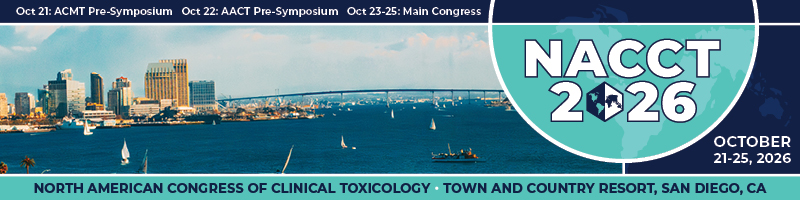
2026 | San Diego, California | October 21st - 25th
Hotel Booking and Travel Scams
ExpandMember and Partner Security Notice: Be Alert for Hotel Booking and Travel Scams
As you prepare for upcoming meetings and travel, please take a moment to read this important security notice from Veritas Association Management. Scammers are using realistic messages, including real reservation details, to steal payment and personal information. Know what to watch for and how to protect yourself.
A message from Veritas Association Management
As members prepare for upcoming meetings, conferences, and travel, we want to share an important security reminder about hotel booking scams.
Cybercriminals are increasingly using realistic-looking messages that appear to come from hotels, booking platforms, or travel providers. These messages may reference real reservation details, including hotel names, arrival dates, departure dates, or payment amounts. Because the information looks familiar, the message can feel legitimate.
Please remember:
Real reservation details do not always mean the message is safe.
What to watch for
A scam message may arrive by email, text message, WhatsApp, or another messaging platform. It may claim that:
- Your hotel reservation needs to be verified
- Your payment card must be re-entered
- Your reservation may be canceled unless you act quickly
- There is a problem with your booking
- You need to click a link to confirm your stay
These messages often include a link to a fake website designed to steal credit card information, login credentials, or other personal details.
What Veritas and our association partners will not do
Veritas, our association partners, and official event teams will not ask members to provide payment information, login credentials, verification codes, or sensitive personal information through an unsolicited text message, WhatsApp message, or suspicious third-party link.
If payment or hotel information is needed for an event, members should use the official event website, registration platform, housing portal, or verified hotel contact information.
How to protect yourself
Before clicking any hotel or travel-related link, take a moment to verify the message.
If you receive a suspicious message:
- Do not click the link.
- Do not enter payment information.
- Do not provide login credentials or verification codes.
- Go directly to the official event website or registration platform.
- Contact the hotel using a phone number from the hotel’s official website, not the message.
- Contact the association’s event team if you are unsure.
Red flags
Be extra cautious if a message:
- Creates urgency or threatens cancellation
- Requests payment card information through a new link
- Comes from an unfamiliar phone number or email address
- Uses WhatsApp, text message, or email for payment verification
- Sends you to a website that does not match the official hotel, event, or registration site
- Asks for one-time codes, passwords, or account access
- Contains unusual grammar, formatting, or branding
When in doubt, verify directly
Scammers are becoming more sophisticated. They may use accurate details to make their messages seem trustworthy. The safest response is to slow down and verify through an official source before taking action.
For event-related questions, please contact the official partner event support team.
Your security matters to us, and we encourage all members, attendees, exhibitors, and partners to stay alert when receiving travel or hotel-related messages.
NACCT 2026 Pre-Symposia

Title:
Fungus Among Us: Updates in the Toxicology of Mushroom Poisoning
Description:
This symposium will examine key aspects of mushroom toxicology, including basic science, foraging mix ups, updates on novel mechanisms of toxicity, emerging clinical syndromes, evolving regulation on cultivated psychoactive mushrooms, and a focus on incorporating lessons from several recent mushroom poisoning outbreaks—including death cap cases—to highlight challenges in clinical recognition and public health response. Bringing together clinicians, toxicologists, public health experts, and mycologists, the program will explore both classic and emerging issues in the field. Overall, the goal is to connect clinical care, public health, and research to improve recognition and management of mushroom-related toxicities.
Learner Objectives: TBA
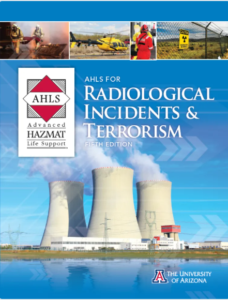
AHLS for Radiological Incidents & Terrorism
Date: October 21, 2026
Time: 4:00-8:00 PM
AHLS for Radiological Incidents & Terrorism is a 4-hour course that trains healthcare professionals to medically manage patients with acute radiation syndrome and internal contamination with radionuclides.
This course consists of didactic lectures and a tabletop exercise. This course also includes multiple-choice pre- & post-tests that are formative assessments only. No minimum score is required, but participants must attempt both exams to complete the course.
After completing AHLS for Radiological Incidents & Terrorism, participants will be able to:
- Describe the basics of radiation physics
- List different types of radiation detection equipment
- Discuss the evaluation and management of patients contaminated with radioactive materials
- Discuss the evaluation and management of patients exposed to ionizing radiation
Anticipated Speakers:
Frank Walter, MD, FACEP, FACMT, FAACT, Physician, Toxicologist
Ziad Kazzi, Physician, Toxicologist
Diane Hindman, Physician, Pharmacist
Emily Kiernan, Physician, Toxicologist
 Title: Quantifying and Communicating Uncertainty: Assessing, Interpreting, and Balancing Risk in Clinical Toxicology
Description:
Clinical toxicologists are often faced with the challenge of making difficult decisions. Decisions about patient care, public health, clinical guidance, and prevention measures. Risk is an ever-present factor in the decision making process. In toxicology, we rarely know the true risk when we need to make or communicate a decision to a patient, a colleague, or the public. This symposium explores how we identify, interpret, and act on risk, particularly when evidence is limited or evolving. The sessions will examine how risk is evaluated in the literature, understood at the bedside, and communicated to patients, families, care teams, and the public. Speakers will highlight the balance between benefit and harm when considering high-resource interventions, emerging treatment strategies and antidotes, prognosis, prevention, and public health strategies. The sessions will prepare health care professionals with a practical framework to make thoughtful, patient-centered decisions in the context of uncertainty.
Learner Objectives:
- Discuss the impact of risk and uncertainty on the evaluation, treatment, and monitoring of poisoned patients, including prognostic tools and antidotal therapies.
- Analyze and debate novel strategies for evaluating and treating poisoned patients, including extracorporeal membrane oxygenation and plasma exchange (PLEX/TPE).
- Investigate the role of public health interventions, risk communication, and consensus based guidelines for preventing poisoning and promoting safe use.
Agenda:
- When Uncertainty Meets Certainty: The Acetaminophen Story
- Reinventing the Wheel - Should We Be Using Other Prognostic Tools to Augment the Acetaminophen Nomogram?
Summary: An overview and critical appraisal of APAPxAT, APN, Bayesian forecasting, and biomarkers to improve risk prediction in patients with acetaminophen overdose. The talk should briefly review the benefits and limitations of using prognostic tools when caring for poisoned patients. - Building Consensus - Development and Implementation of Consensus Based Pre-Hospital Guidelines
Summary: Using the acetaminophen out-of-hospital triage guideline as a framework, this session will explore the process and pitfalls of developing consensus based pre-hospital guidelines for poisoned patients. The talk should describe how risk is incorporated into this development process. - Acetaminophen & Pregnancy - The Challenges of Communicating Nuance and Risk
Summary: An overview and critical appraisal of the literature evaluating an association between acetaminophen and developmental issues (ASD, ADHD, etc.), including strategies for communicating risk to patients and the public. - Stop Right Now - Discontinuing NAC in Acetaminophen Poisoned Patients (Moderated Debate)
Summary: A moderated debate with two speakers presenting the case for stopping n-acetylcysteine treatment at 12 hours vs. 20-21 hours.
- Reinventing the Wheel - Should We Be Using Other Prognostic Tools to Augment the Acetaminophen Nomogram?
- Risk and Resources: Managing Uncertainty in Critically Ill Patients
- Are We a Go for ECMO? - Should Expanded Access Mean Expanded Indications?
Summary: ECMO is becoming increasingly common in patients with drug-induced cardiac toxicity, including toxicity from bupropion, non-dihydropyridine calcium channel blockers, beta-blockers, and tricyclic antidepressants. As access to ECMO expands, it is critical that the risks and benefits are considered for other medications, including dihydropyridine calcium channel blockers and colchicine. - Bridging the Gap - Therapeutic Plasma Exchange for Toxin Associated Hepatotoxicity
Summary: An overview of PLEX and the role for therapeutic plasma exchange in patients with toxin associated hepatic failure. - Should we Dialyze That? - Developing and Implementing Consensus Based Guidelines for Extracorporeal Therapies
Summary: Using the Extracorporeal Treatments in Poisoning Workgroup (EXTRIP) guidelines as a framework, this session will explore the process and pitfalls of developing consensus based guidelines for extracorporeal therapies in poisoned patients. The talk should describe how risk is incorporated into this development process. - Going Back to College - The Role of Organ Transplantation in Poisoned Patients (Moderated Debate)
Summary: A moderated debate with two speakers presenting on the role for organ transplant in poisoned or overdose patients.
- Are We a Go for ECMO? - Should Expanded Access Mean Expanded Indications?
- Perfect is the Enemy of Good: When Zero Risk Isn’t an Option
- Pesticides, Diet Soda, and Pickled Veggies - Contextualizing Cancer Risk
Summary: The International Agency for Research on Cancer (IARC) develops evidence-based monographs to identify causes of cancer and improve cancer prevention. This talk should include an overview of the IARC process and a critical appraisal of the benefits and limitations of the IARC methodology, classification system, and reporting mechanism. - Overamping - Preventing Harms of Stimulant Use
Summary: Stimulant use disorder is a growing public health crisis and treatment access is limited. Patients with stimulant use disorder can have high rates of emergency department visits for paranoia, delusions, agitation, and other symptoms of overamping. Risk reduction interventions, including chill packs, PrEP/PEP, and safer use strategies, are a potential tool for reducing stimulant associated morbidity and mortality. - Defining Safe Consumption - A Critical Appraisal and Update on Safe Consumption Strategies for Patients with Substance Use Disorders
Summary: Safe consumption strategies, including safe consumption sites or overdose prevention centers, are one potential strategy for decreased opioid and drug-related morbidity and mortality. The talk should include a discussion of safe consumption resources for patients using opioids, stimulants, and other drugs. - Reframing the Narrative - Medical and Non-Medical Use of Psychedelics (Moderated Debate)
Summary: A moderated debate with two speakers presenting on medical and non-medical use of psychedelics. - Understanding Risk - Best Practices from an Expert Panel
Summary: A moderated 4-5 person panel with Q&A.
- Pesticides, Diet Soda, and Pickled Veggies - Contextualizing Cancer Risk
NACCT 2026 Information
Click the button below to access the NACCT 2026 Abstract Manuscript!
Key Dates
- February 1, 2026: Abstract and Symposia Submissions Open
- April 1, 2026: Symposia Submissions Close
- April 15, 2026: Symposia Submission Notifications
- May 4, 2026: Abstract Submissions Close
Join us for an evening of friendly competition, local flavor, and networking at the NACCT Night Out: Brews, Bites, & Bragging Rights! Held in beautiful San Diego on Saturday, October 24 from 7:00 PM – 9:30 PM, this interactive social event will feature one hour of team trivia followed by beer tastings from three local breweries and plenty of opportunities to connect with colleagues in a relaxed setting.
Whether you're in it for the trivia title, the craft brews, or the camaraderie, this is the perfect way to unwind and experience San Diego with fellow attendees.
Non-alcoholic beverages and food will be available during this event.
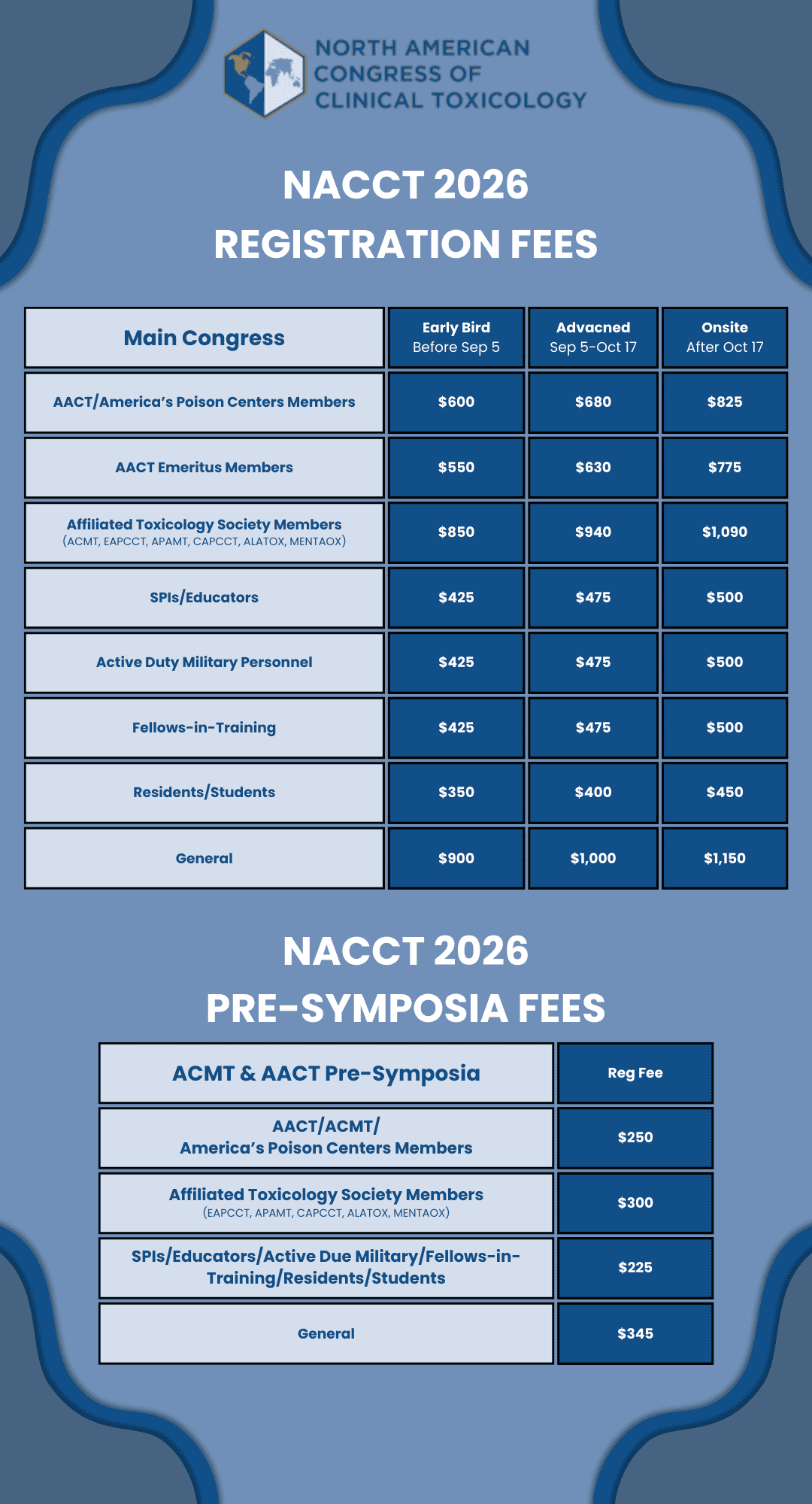
Registration Fee: $150 per person
NACCT is the premier meeting of toxicologists, medical professionals, and researchers in clinical toxicology. Don’t miss this opportunity to be part of the future of toxicology — October 21–25, 2026.
➡️ Secure your spot now and take advantage of early bird rates! Early Bird rates end on September 4, 2026!
CANCELLATION POLICY:
Any cancellations received after September 21, 2026, will be assessed a $150 processing fee.
Click the link below to view the NACCT Schedule at a Glance. Please note that this schedule is subject to change.
NACCT2026 Schedule at a glance(opens in new tab)
NACCT 2026 Event Website
View the full agenda, sessions, and speakers on the NACCT 2026 event site. Build your personalized schedule and plan your week.
(opens in new tab)(opens in new tab)
If you need an Invitation letter to enter the US for the NACCT 2026 meeting, click the button below:
HOTEL:
Town and Country Resort – San Diego
Discover the perfect blend of modern comfort and classic California charm at the Town and Country Resort in the heart of San Diego’s Mission Valley. This newly renovated resort offers bright, contemporary guest rooms, lush outdoor spaces, and a vibrant atmosphere ideal for conferences, family travel, and everything in between. Guests can enjoy multiple on-site restaurants, relaxing pools with cabanas, and easy access to San Diego’s top attractions—including the zoo, Balboa Park, and world-famous beaches. With expansive meeting venues and a welcoming Southern California vibe, Town and Country delivers a memorable stay for every traveler.
Address: 500 Hotel Circle North, San Diego, CA 92108
(opens in new tab)
(opens in new taHotel Cancellation Policy: Reservations must be canceled or modified at least 48 hours prior to arrival, by 6pm, to avoid a one night charge. In an event of a guest No Show, a fee of one night's room rate will be charged.
Check- Out Time: 11:00 AM
A deposit of 1st night's room and tax is charged at time of booking to the credit card or debit card used to reserve the room.
Children 18 and under stay free in parents room.
The Town and Country Resort is sold out for NACCT. For cancellations and changes, please contact the resort at 800-772-8527. If you are still needing accommodations, please use the link below to book at the NACCT Overflow property:
Courtyard by Marriott San Diego Mission Valley/Hotel Circle
595 Hotel Circle South San Diego, California, USA, 92108
GOLF:
For those attendees wishing to play golf during your stay: Beginning in late July, NACCT attendees will receive a discounted tee time at Riverwalk Golf Course. Use the promo code: NACCT to receive 20% off your tee time. Visit https://riverwalkgc.com/ for more information and to reserve your tee time!
TRAVEL:
Getting There & Airport
- Closest airport: San Diego International Airport (SAN) — approximately 7 miles (about a 15–20 minute car ride) from Town and Country Resort.
Attendees flying in can take a taxi, rideshare, or shuttle from either airport to the Resort.
While public transportation from the San Diego Airport to the Town & Country Resort is possible, it will require riders to take a bus to downtown San Diego to connect to the Green Line of the San Diego Trolley. Total travel time is around 45 minutes depending on connection waits.
PARKING:
- If you are parking at the hotel, you are entitled to discounted parking fee of $20.00 per day. Let the front desk know you are with NACCT when you check in.
INTERNATIONAL INVITATION LETTER:
If you need an Invitation letter to enter the US for the NACCT meeting, please complete the form here.
If you are a student or trainee and would like to apply for a travel award to use for this conference, the descriptions are found at the links below. The deadline to apply for either award is July 1, 2026.

Official NAACT 2026 App
We are pleased to announce the release of the NACCT 2026 app which is accessed from within an app called 'eventScribe'. The App can be used on phones and tablets to access the event materials at your fingertips.
Use the app to:
• Review the schedule and create your personal itinerary
• View the presentations and take notes directly on the slides
• Connect with fellow attendees, share information and schedule meetings
• Plan which exhibitors you would like to meet
Install the free 'eventScribe' app and then open it and search for ‘NACCT 2026’. You will be prompted to log in with your Username and Password (Your badge number).
NACCT 2026 session or pre-symposium organizers should have received an email notification regarding their session proposal's acceptance on April 15. If you did not receive this notification, email nacct@clintox.org.
All session organizers and speakers must sign a COI form to present at the NACCT meeting. This form was emailed in early August.
Presenters Checklist
Presenters Checklists
- Abstract Submission Guidelines
- Lightning Oral Presenter Checklist
- FIT Platform Presenter Checklist
- Platform Session Presenter Checklist
- Poster Presenter Checklist
Production
- Poster boards are 8’ in length and 4’ in height. Maximum printing area is 7’6” x 3’6” as there is a 2” border around the boards.
- Keep text to a minimum. To do this, edit your material down to essential words, using tables, lists, figures, and diagrams to avoid the use of too many words.
- Use short, bulleted sentences rather than lengthy paragraphs.
- Put the material in the structure of the abstract: Introduction, Methods or Case Report, Results or Case Discussion, and Conclusions.
- A bibliography is optional. You may wish to print up a few bibliographies to be handed out to those with special interest.
The Title Panel
- All printing is bold. All lines should be centered and the title placed at the top of the board. It may extend the full width.
- Title: ≥ 60 points (72 points is best), upper case; Authors: 48 points, lower case.
- Institution: 36 points, lower case.
The Body of the Poster
- Headings: 36 points bold; may be lower or upper case and/or italics.
- For Studies: Background, Methods, Results, and Conclusions.
- For Case Reports/Series: Background, Case report(s), Case Discussion, Conclusions **References are encouraged, but are optional**
- Text: 18 to 24 points.
Figures and Pictures
- These should be at least 5 x 7 inches.
- All figures and pictures should have titles, captions, labels or legends.
- If more than one figure is used, each should be numbered.
Click the button below for CE information for NACCT 2026. More information on how to claim CE will come out towards the end of the conference.
NACCT 2026 CME Information(opens in new tab)
All meeting attendees have the option to add continuing education credits to their registration.
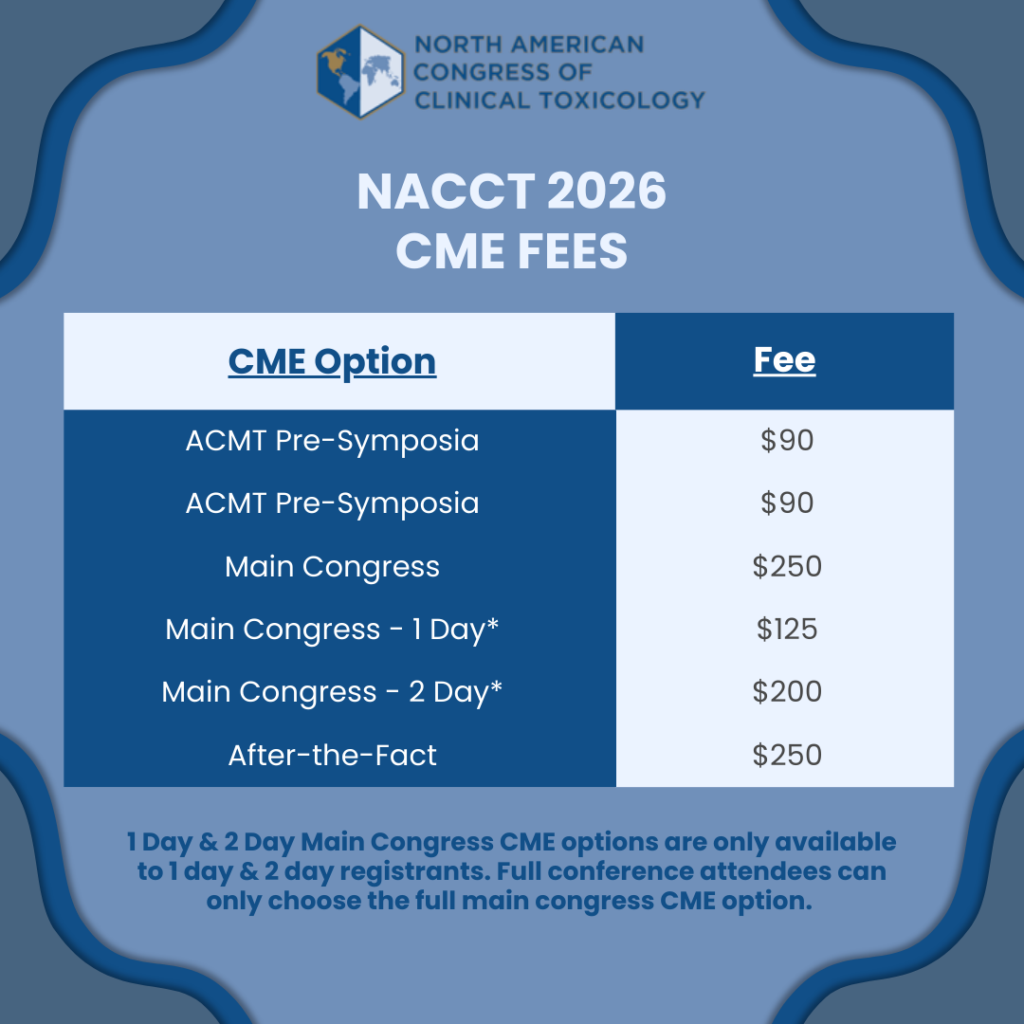
All applicants registered for CME will receive an email at the conclusion of the 2026 Congress with a link to check off their list of sessions attended and complete the overall conference evaluation before they print their certificates.
This event would not be possible without the generous support of the following organizations.
Diamond Partner

Silver Partner
Exhibitor

Organizations interested in exhibiting or sponsoring the 2026 NACCT meeting can review the exhibitor and sponsor prospectus below:
NACCT 2026 Industry Partner Prospectus
Questions? Email NACCT Industry Relations Account Manager, Bethany Radke, at bradke@veritasamc.com.
Exhibitor Hours:
Friday, October 23, 2026 - 8:30am - 5pm
Saturday, October 24, 2026 - 7:30am - 4:30pm
Sunday, October 25, 2026 - 7:00am - 11:30am
NACCT 2026 Yogalates
Town and Country Resort — San Diego, CA Saturday, October 24, 2026 | 6:30 AM - 7:30 AM | Palm Room 7
Yogalates blends the mindful movement and flexibility of yoga with the core-strengthening benefits of Pilates. The energizing, low-impact class focuses on strength, balance, mobility, and mindful breathing - leaving you feeling stronger, more centered, and refreshed. Please Note: Yoga mats will not be provided for this session. Towels will be available for participants to use during the class; however, attendees are welcome and encouraged to bring their own yoga mat if they have one available.
All levels are welcome!
Register today using the link below. Registration will be available onsite as well.
Yogalates Registration & Participation Waiver Form(opens in new tab)
NACCT 2026 Tox Trot 5K Run/Walk
Town and Country Resort — San Diego, CA Saturday, October 24, 2026 | 6:30 AM
Lace up your sneakers and kick off your NACCT 2026 morning with our annual Tox Trot 5K Run/Walk! Join your colleagues for a scenic route starting at the beautiful Town and Country Resort — a great way to connect, get moving, and start the conference day on a high note.
Want to commemorate the occasion? A limited-edition event t-shirt is available for $25. Be sure to add your shirt to your order when you complete the registration form — shirts must be requested at the time of sign-up.
Register and order your shirt through the conference registration form by Sunday, October 4th. Shirts will not be available for sale onsite at NACCT.
Preview your shirt by clicking on this link(opens in new tab)
Riverwalk Golf Club
1150 Fashion Valley Road San Diego, CA 92108
For those attendees wishing to play golf during your stay: NACCT attendees receive a discounted tee time at Riverwalk Golf Club. Use the promo code: NACCT to receive 20% off your tee time.
Click on the link below for more information and to reserve your tee time!
Riverwalk Golf Club Tee Times(opens in new tab)(opens in new tab)
2025
Click the button below to access the NACCT 2025 Abstract Manuscript!
Didn't attend the 2025 meeting?
If you did not attend NACCT 2025, you can use the button below to register for access to the NACCT 2025 program.
*Not all NACCT 2025 sessions were recorded
NACCT 2025 Sessions & After-the-Fact CE
After-the-Fact CE
Need some CE? NACCT 2025 After-the-Fact CE can be purchased and claimed for up to six months after the content is posted.
All applicants who purchase the NACCT2025 for CE will receive an email after purchasing the content with a link to access the sessions and the link to check off their list of sessions attended and complete the overall conference evaluation before they print their certificates.
All CE credits must be claimed by 8/20/2026.
Learner Notification for NACCT 2025 Content
Future Meetings
2026 - October 21-25, San Diego, CA
2027 - September 15-19, Charlotte, NC
Past Meetings
2025 - September 17 - 21, Chicago, IL
2024 - September 19-23, Denver, CO
2023 - September 27-October 1, Montreal, CAN
2022 – September 14-18, San Francisco, CA
2021 – October 13 -17, Virtual Meeting
2020 – September 10-14, Virtual Meeting
2019 – September 23-27, Nashville, TN
2018 – October 25-29, Chicago, IL
2017– October 11-15, Vancouver, BC
2016 – September 12-16, Boston, MA
2015 – October 8-12, San Francisco, CA
2014 – October 17-21, New Orleans, LA
2013 – September 27-October 2, Atlanta, GA
2012 – October 1-6, Las Vegas, NV
2011 – September 21-26, Washington, DC
2010 – October 7-12, Denver, CO
2009 – September 28-October 3, San Antonio, TX
2008 – September 11-16, Toronto, Ontario, CAN
2007 – October 19-24, New Orleans, LA
2006 – October 4-9, San Francisco, CA
2005 – September 9-14, Orlando, FL
2004 – September 9-14, Seattle, WA
2003 – September 4-9, Chicago, IL
2002 – September 24-29, Palm Springs, CA
2001 – October 4-9, Montreal, Quebec, CAN